
Two hundred years ago in 1818, a group of men and women gathered at the County Library in Truro to establish a society of learning and culture that still exists and thrives today.
The Royal Institution of Cornwall (RIC) runs the Royal Cornwall Museum and the Courtney Library – both of them housed in the impressive Grade II listed building in River Street that the RIC has owned since 1919. Thousands of objects have been collected and exhibited there – showcasing the outstanding contribution Cornwall has made over the centuries to science and the arts.
In celebration of this important bi-centenary, the Royal Cornwall Museum is telling the story of extraordinary Cornish achievement through new exhibitions, lectures and events. Our history is full of men and women who have broken down barriers of class, gender and wealth to prove to the world that anything is possible. Inspired and inspiring, they provide a lesson for us all.
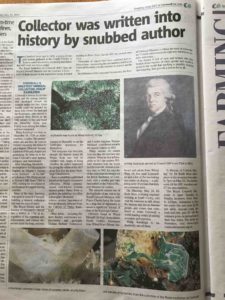 Cornwall is famous for its minerals and the mining industry that developed around the treasure under our feet. Great wealth could be accrued by those who owned the land and the Rashleighs, who moved to Cornwall from Devon in the sixteenth century to buy and build the Menabilly estate near Fowey, were among the richest and best connected.
Philip Rashleigh was born on 28 December 1729 in Aldermanbury, London. His parents’ eldest son and heir, he went to Oxford University but failed to get a degree. Minerals became a passion of his and, despite not graduating, he went on to become Cornwall’s most famous antiquary and mineralogist.
After inheriting Menabilly (the inspiration for Manderley in Daphne du Maurier’s famous novel ‘Rebecca’) on his father’s death in 1764, Philip served as Fowey’s MP from 1764 to 1802 – eventually becoming ‘Father of the House of Commons’. Most of his time, however, was spent at home in Cornwall, building a mineral collection that was the envy of many. The Royal Society and the Society of Antiquaries elected him as Fellow in 1788 in recognition of his expertise and achievement and curious observers made the long, arduous journey to Menabilly to see the 4000 plus specimens for themselves. Not everyone was welcome though – famous writer Sir Walter Scott was told he couldn’t visit. Angry at being rebuffed, the author responded by making Philip the villain Rashleigh Osbaldistone in his 1817 novel ‘Rob Roy’.
Keen to establish a published record of the hugely impressive collection, Philip commissioned well-known Cornish enamel painter Henry Bone to produce the paintings for a first colour-plate-illustrated volume, entitled ‘Specimens of British Minerals, Selected from the Cabinet of Philip Rashleigh’. Other artists – including his sister Rachel, well-known watercolourist and geologist Thomas Richard Underwood and London engraver Thomas Medland – contributed towards the second volume in 1802.
Philip married his cousin Jane but did not have any children. When he died at Menabilly in 1811, his nephew William inherited both the house and the minerals. Almost a century later, in 1902, the majority of the collection was bought for the Royal Institution of Cornwall, with a smaller part later bequeathed to the Natural History Museum in London.
The minerals remain one of the highlights of any visit to the Royal Cornwall Museum, with Prince Charles being the latest in a long line of dignitaries to spend a significant amount of time in the Rashleigh Gallery. Olivenite found in Wheal Muttrell (St Day), Bismuthinite, (South Crofty), Bournonite, from Wheal Boys (Mount Ambrose) and calcite from Wheal Wrey (St Ive, near Liskeard) are just a few of the fascinating specimens on display – a glittering array of crystals that truly are a treasure trove.
On Thursday 24 May, Dr Keith Russ, a mining engineer working at South Crofty, will visit the museum to talk about the famous and not-so-famous people and mines that combined to make Cornwall a world-leading centre of mining invention and expertise.
Philip Rashleigh is undoubtedly one of them.
‘A History of Cornish Mining’ by Dr Keith Russ takes place at the museum from 6-7pm on 24 May. The lecture costs £4 for RIC members and £7 for non-members.
The Royal Cornwall Museum is open Tuesday to Sunday inclusive, from 10am to 4.45pm. Admission is free for under 16s and costs £5.50 per adult. Anyone using the Park & Ride, gets £1 off the entrance price on production of their bus ticket. For more information, visit the website.